
Everyone’s a critic
Note: I’d like to preface this post with a gentle reminder to my readers that this is a personal blog focused on my journey with genetic genealogy, and how the lives of my ancestors impact my own life and identity. This is NOT a history dissertation and should not be treated as such. I will make my best effort to present factual information, however I’m a storyteller and not an academic, so anything you read here should not be taken as historical fact or based on rigorous academic evidence. This blog is “for entertainment purposes only” as they say.
Note about my Note: I wrote a blog, put it out in the world, and of course my first visitors were my family of academics. And they had opinions! My harshest critic, my sister said it “reads like a too woke white girl claiming some imaginary ethnicity and racial background to seem cooler” and suggested my next post should be about how cringey it is to research how you’re descended from Pocahontas (coming soon…). My mom was worried I didn’t have enough evidence to support my claims about our ancestors’ identities and felt I needed to be very specific in wording things as theories or suspicions until I could show my documented evidence to support my conclusions (also coming soon…). My dad and aunt said it sounds neat and gave me a few stories from their side of the family I could dig into (thanks!).
My son Junior Historian, a current undergraduate History major, said I should make sure I use history books as sources and not Wikipedia, and to make sure I use Chicago style citations because that’s what “real historians” use. Such a smarty pants! He’s also interested in military history and wanted to know more about our Revolutionary War ancestors and thought that would be an appropriate topic for a 4th of July post.
This is life with a family of academics, of which I am not one.
Puritans and the Patriarchy

I was not especially interested in US History as a kid. I was your typical jaded Gen X Riot Grrrl raging against the machine during the elder Bush era and I found most of what was taught in school about our country’s foundations was too patriarchal and puritanical for my liking. I loathed reading Cotton Mather, on what turns out is a deeply ancestral level, but that’s a story for another day. Even as an English major I found a lot of American literature was too centered around what I refer to as “rugged frontier man lost in the wilderness with his dog” stories (anything by Jack London), and I can imagine my ancestors grew tired of dealing with these lost boys in their own lives as well.
I am a Bicentennial Baby though, born in the year of our nation’s 200th birthday and struggling to find any sense of patriotism to celebrate this 250th year as I turn 50 myself, so I hoped digging into the Revolutionary War era would help me reflect on an aspect of US History I’m not very familiar with.

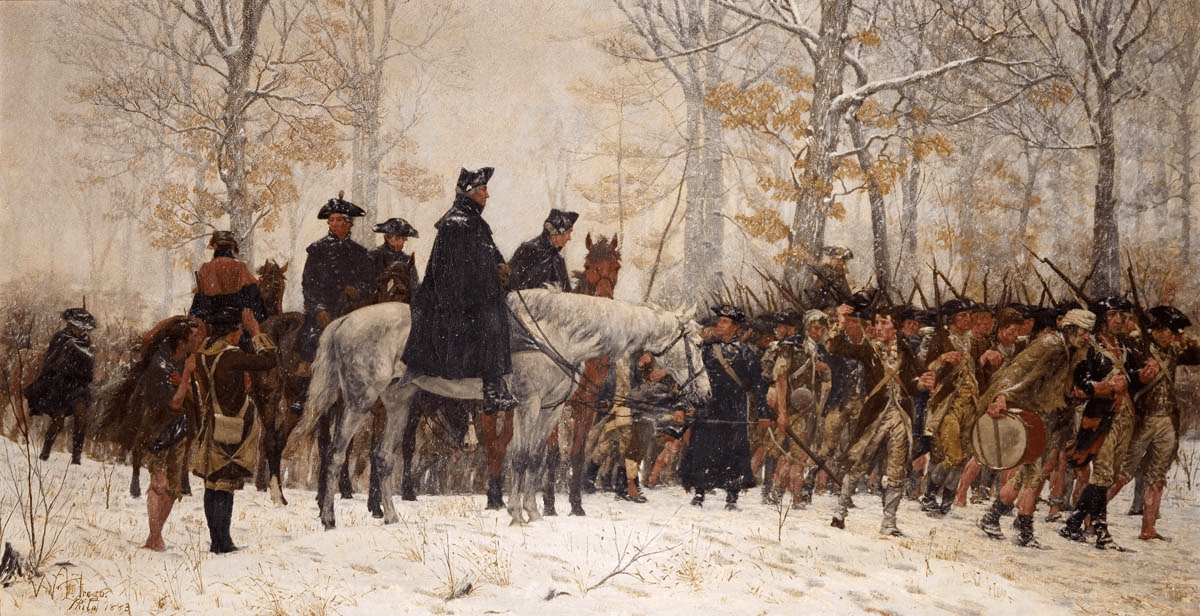
Most of what I was taught about this era was the typical founding fathers propaganda, Boston Tea Party, Paul Revere, Benedict Arnold, and Washington crossing the Delaware. Mostly I remember the soldiers were often freezing to death1, and I really hate to be cold. Turns out there’s a genetic condition that probably causes that for me, which explains a lot about my life, where I choose to live, and possibly the migration paths of some of my ancestors as well.
I know the truth of America’s founding is more complicated, brutal, and unequal than the myths we were taught in school, but I believe most of us still believe in those ideals of freedom and equality we were told our country was founded on. My son is especially patriotic, which often confuses people about his political beliefs. As he explains it, he was raised in the Obama era so for most of his childhood our President was someone he deeply admired, and he felt proud and hopeful about the future of our country and democracy.
I told my son I didn’t feel very patriotic this year and he reminded me of something his late father told him in 2016 when he wondered how he could still love his country if he doesn’t respect the president? He said this is just one president and we’ve had really bad ones before and will have them again, but the country is much more than just the president, and you cannot call yourself a patriot if you stop loving your country when a bad president comes around. This 4th of July my son reminded me to remain hopeful for what Obama invoked in 2024 referencing Abraham Lincoln, another great president speaking on the eve of civil war: A restoration of our bonds of affection. An America that taps the better angels of our nature.2
My personal hope for restoration, once we finally move past this dark period of presidential history, starts with reparations, land back, and universal healthcare. If we truly want to live up to our potential as a nation, we must first remember that “nobody’s free until everybody’s free” ~ Fannie Lou Hamer.3
Hopey Feely
So with my head full of Obama-era “hopey feely,” I embarked on a deep dive into my Revolutionary War era ancestors and discovered there’s quite a lot of them as most of my family has early colonial English origins, including apparently several from the Mayflower and others of the Puritan “Great Migration” era and early Jamestowne colonists. All the puritans and patriarchy I spent my entire life rejecting. Cringe is an understatement.


On my maternal side, the only post-colonial immigrants that I’m aware of, my 3rd great-grandparents Elizabeth Banks and John Pilcher came from London, England to St. Louis, Missouri by 1850. On my paternal side, my great-grandmother Emma Schroeder was adopted from Hainichen, Germany as a baby in 1893 by Rudolph and Margaret Schroeder, a German couple who immigrated to Boston, Massachusetts in 1889. Emma’s future husband Paul Kunze was a butcher who came from Auma, Germany to Cambridge, Massachusetts when he was 22 in 1910. Every other branch in my family tree had someone here for the Revolution. And from what I can tell, if you were here, you could hardly escape feeling the impact.
Knowing I wouldn’t be able to research a feature on any one individual in time for the 4th of July given my son’s insistence on an extensive list of primary sources and proper citations, I thought a good place to start might be a quick catalogue of all my ancestors who were Revolutionary War veterans, with some highlights about some of their roles. Seems simple enough? Turns out nothing is that simple in genealogy research.
Making a list
I started with compiling a list of ancestors who were alive during this time period by visiting my Ancestry.com family tree. This took a bit of experimenting but I used the List view feature and filtered by:
- Direct line ancestors
- Paternal/Maternal line to create two separate lists
- Events & Places:
- born 1676-1770
- died 1775-1865


Note: filtering by “Any Event” during the primary Revolutionary time period ~1775-17834 did not produce the needed results as this requires a specific unique event (birth, marriage, census, death, etc.) saved to the ancestor’s profile during this time period. There’s no single search filter that’s perfect for finding all ancestors who were alive during a specific time period.
Some of these may be Pro subscription tools so you might not see the same filters in your list view, but I personally find it worth the cost if you’re doing regular research like I am. The resulting list included a small number of ancestors in other countries and those who may have been too old or young to serve, but they were easy enough to skip, as adding locations might have missed a few where I don’t have a birth or death location documented consistently across my tree.
The military campaign started in 1775 so I made the assumption that anyone 100 years old at this point in history was not likely to be involved in any notable way, but there could be some teenagers enlisting by the end of the war in 1783 so I extended the birth year to 1770. Even those too old to serve were still impacted though. For example, my paternal 6th great grandfather Deacon Henry Prentice was “removed to his son’s, in Holliston, when the revolutionary army occupied Cambridge”5 and passed away at 85 in 1778.

There’s also no filter for gender so I had to identify the men vs. women by name, and as Abigail Adams (no relation) famously said, we should “remember the ladies”6 who also had a role in the war efforts. Many women were left managing households on their own and taking on other traditionally male roles, facing food and labor shortages, economic collapse, supply chain disruptions due to blockades, not to mention the threat of violence, destruction of property, and home invasions as troops moved through communities. Many women were left widowed and children orphaned.
Checking it twice
I started on my maternal side thinking I would skim through their profiles, figure out if they had served, and compile my quick list of “war heroes”. Turns out I have 133 ancestors I’ve identified on my maternal side who were in America during the American Revolution era, so this was going to be quite the undertaking.
As I reviewed my list, I added Ancestry’s built-in tags for “Revolutionary War Era” and “Revolutionary Soldier” under Defining Characteristics, as well as “Military Service” under Life Experience Tags on each individual profile for future reference. I added the whole list to the Revolutionary War Networks as well, which is noted as a Beta feature so I’m not quite sure yet what it does but I’ll dig in and write a review of it in the future. If you’ve used this feature and have any tips, please share in the comments below!
I should preface this by clarifying when I first started researching my family tree on Ancestry, I made the mistake of accepting all the hints they offer for parents of people in your tree because I wanted to get a big picture view of my family. I strongly advise against this approach because you’ll end up with a lot of mistakes and undoing a lot of it later.

With such a long list, I started at the top with Simon Adams Sr. my maternal 6gg, of Fairfax, Virginia who served 5 Oct 1775 – 1783 as a Private in Virginia’s 6th Regiment. As I dug deeper into his records and compared his WikiTree entry to my Ancestry data and his Sons of the American Revolution (SAR) profile,7 I realized I might have the wrong guy or he might not even be the father of my ancestor George Wiley Adams of Tennessee since the wives didn’t match and the date and location of his birth and death were inconsistent across all three records. Additionally at least one of these Simon Adams was an enslaver according to the 1800 Hillsboro, North Carolina census, so not someone I want to celebrate as a war hero. And as I dug deeper I realized George might not even be the father of my ancestor Phillip Adams who “started life without means, but became a successful farmer”8 in Missouri and whose father is listed as Henry Adams on WikiTree.
Continuing through my list on my maternal side, I found a number of other similar circumstances of men who probably did serve in the war, might have also been enslavers, and were potentially not even related to me. It’s pretty clear from this exercise that I need to do a massive cleanup of my tree before I dig too much deeper in my mom’s side, but I was determined to find at least one hero to write about.
Aaron Burr, Sir

The list was considerably shorter with 46 people alive during this time period on my dad’s side as half his family was still in Germany at the time of the Revolution, so I started there. Right at the top of my list I spy Eunice, Esther, Ann, John, and Peter Burr from Fairfield, Connecticut. Now much of what I know about Aaron Burr comes from taking my son Junior Historian to the musical Hamilton so I’m thinking oh great, are we related to the guy who infamously killed Alexander Hamilton in a duel? Of course I promptly put the soundtrack on to get myself in the mood to research the Burr family tree. Short answer, yes 3rd Vice President Aaron Burr Jr. is my 1st cousin 9x removed (twice over) and also my 2nd cousin 10x removed, or at least I think that’s how the cousin removal system works.
My paternal 5th great grandfather John Burr Jennings’ parents are Eunice Burr and David Jennings. David’s mother is Esther Burr, who is Aaron Burr’s first cousin. Additionally, John Burr Jenning’s wife Esther Burr Meeker (who is also his step-sister via his father David Jennings and her mother Abigail Beers Meeker’s second marriages) is the granddaughter of Ann Burr, Esther Burr’s sister. Esther and Ann’s father Peter Burr was a brother of Rev. Aaron Burr Sr., the second president of College of New Jersey (now Princeton) and father of VP Aaron Burr Jr. If you’re as lost as I am, see the three Burr women and VP Aaron Burr circled in the tree below, as well as indicators of where the Burr ancestors are duplicated in the tree.

Eunice Burr and David Jennings are also second cousins via their shared great grandfather Joshua Jennings Jr. Additionally, Eunice Burr’s father John Burr is Peter and Rev. Aaron Burr’s 2nd cousin via their shared great grandfather and patriarch of the American Burr family, Jehue Burr Sr an immigrant from England who “arrived in New England as part of the Winthrop Fleet in 1630 and was made freeman of Roxbury, Massachusetts May 18, 1631. He went to Springfield, Massachusetts in 1636 (as one of its founders) and then to Fairfield, Connecticut after 1641” according to his WikiTree entry.9
I will admit the further I dug into these family trees and their source data, the more confusing it got, as genealogy often doesn’t “remember the ladies” and they all have similar names and tangled trees, so I will update this post if I find conflicting info later. I did discover as I was researching that WikiTree had incomplete information for many of these women, so I have submitted updates to their pages as well. If you see any mistakes in my research or have any helpful resources about the Burr family tree, please feel free to comment below.
A Complicated Hero
Perusing Aaron Burr’s WikiTree page to better understand the context of the family story, I learned he had lost both of his parents and grandparents by the age of 3 and was passed around the family until his maternal uncle Timothy Edwards (no relation to me) took him in.10 Lieutenant Colonel Burr’s Revolutionary War highlights from 1775 to 1779 include serving with Benedict Arnold and George Washington, devising an escape route for 5,000 soldiers, and defending a pass into Valley Forge. You can read more about his extensive war service on his SAR profile.11
Burr seems to be a complex guy with many contradictions, known as both a ladies man and a womanizer, he is alleged to have fathered children with multiple women, but also a “forgotten feminist”12 and supporter of education for women, including his daughter Theodosia. While his father was an enslaver,13 his uncle was not (nor were the Burr’s I’m directly descended from as best I can tell), and his views and legacy regarding slavery were complex as well. He himself became an enslaver when he married Theodosia Bartow, who inherited slaves from her prior husband Jacques Prevost, however “in 1785, Burr introduced a bill for the immediate and unconditional end of slavery for all African Americans. His bill was rejected and in its place a gradual emancipation bill was passed.”14
Burr fathered two children with Mary Emmons from Calcutta, India who was one of those enslaved in his household. Note: it’s unclear from my research at exactly what point she was freed so I’ll update this if I find further info, however family lore indicates they secretly married two years after Theodosia’s death. Their children and grandchildren became noted abolitionists and their son John Pierre Burr was a conductor in the Underground Railroad and worked alongside Frederick Douglass, among many other accomplishments.
I couldn’t possibly do justice to this story as well as John Pierre Burr’s descendant Sherri Burr, so I highly encourage you to read her contribution on the Princeton & Slavery website where I gathered much of this info. Sherri served as the third president of the Aaron Burr Association and is presumably my 10th cousin, and I’m looking forward to reading her book Complicated Lives: Free Blacks in Virginia, 1619-1865 to expand my knowledge on that aspect of my family history as well.
Fairfield, Connecticut: Patriot Stronghold
Other notable Revolutionary War veterans in this branch of my paternal family tree from Fairfield, Connecticut include:
- David Jennings (husband of Eunice Burr and my 6th gg), born 9 October 1755, died 19 June 1845, enlisted in 1776 and served as a 4th Quartermaster in Connecticut.
- Seth Meeker Jr. (father of Esther Burr Meeker and my 6th gg), born ~ 6 May 1759, died 25 Dec 1793 in the West Indies and served as a Corporal in the 4th regiment, Connecticut militia providing local defense of Fairfield.
- Seth Meeker Sr. (Seth Meeker Jr.’s father and my 7th gg), born 12 September 1731, died 1 December 1798 served in October of 1777 as a Private and then a Corporal with Capt. Grey’s company, in Col. Whiting’s Regiment, for a short campaign, the Fishkill. They marched on October 5th and were discharged on October 15th.
The Sons of the American Revolution (SAR) Patriot Research System lists 39 Burrs, 15 Jennings, 21 Beers, 13 Wakemans, and 6 Meekers who served in Connecticut and were presumably the extended family of this branch of my tree. Esther, Ann, and Eunice’s fathers, and Esther’s husband Joshua Jennings do not appear to be involved in specific military service that I can confirm, which is difficult to be certain because many of their family members share the same first names. However, various other brothers, sons, and cousins of these women were involved as the extended Burr family were key players in the war and they presumably lost loved ones as a result as well. Fairfield was also a Patriot stronghold destroyed by British soldiers on July 7, 1779,15 including the burning of Thaddeus Burr’s home,16 and their family lives were all impacted by proximity. The town never fully recovered to its prior status.
Who tells your story?
After falling down numerous research rabbit holes, it became apparent to me I was not going to have something ready to publish in time for the 4th of July, so I paused my research in favor of watching a Revolutionary War inspired movie instead. My husband wasn’t interested in watching Hamilton again so he suggested Mel Gibson’s The Patriot, which he was shocked to discover I’d never seen.

Now before you get started with a rant about how cringey Mel Gibson is and how historically inaccurate this movie was, in particular regarding the main character’s history with enslavement,17 Junior Historian has already informed me. And I was only watching the movie for the entertainment and the patriotic vibes anyways. The key thing I took from it was just how destructive the war was to families much like the Burrs and communities like Fairfield, and how it significantly impacted the lives of everyone in America at the time. And let’s be honest, Mel Gibson does make some epic action movies. If I wanted actual history I’d watch a Ken Burns documentary on PBS instead.
Researching my Revolutionary War ancestors was an interesting exercise, and I certainly learned a lot about the history of this time period as seen through the lives of my ancestors, as well as different techniques and resources for genealogy research. I also recognize I have a lot more to learn, so I plan to continue these Revolutionary Era features throughout this 250th year as I continue researching and untangling the errors in my family tree. Future highlights may include:
- The role of Black and Indigenous patriots of color
- The Overmountain Men and the Battle of Kings Mountain
- The Lawson family and ties to Melungeon communities
- The Green Mountain Boys: Major General Ethan Allen, Benedict Arnold, and Fort Ticonderoga
- Spanish Louisiana and German Coast patriots
- Remembering the ladies
- The Prescott family and Paul Revere’s Midnight Ride
- The Westover Byrd family loyalist vs patriot schism and ties to Benedict Arnold
- Rogers’ Rangers shifting loyalties, and more Benedict Arnold
- SAR, DAR, and how lineage societies impact genealogy research
It may turn out I’m actually not related to some of these families (the Westover Byrds in particular are a dubious connection) but their stories are interesting aspects of American history and shine a light on how and why errors are introduced into family history and the nuances of defining racial identity in US history. I also plan to follow my son’s advice and read some books about the era and key figures, and finally watch that Ken Burns documentary. If you have any recommendations, please share in the comments below, in particular anything about Benedict Arnold who seems to be a recurring nemesis in my family’s history.
Another aspect of this research I plan to continue exploring is how the complex histories of racism, racial identity, and family history shape the making of “heroes” and how the history (and propaganda) of the United States is written and taught. Or to quote the musical Hamilton, “Who lives, who dies, who tells your story?”18
References
A complete list of all the sources cited above! (in the Chicago Style) for Junior Historians everywhere!
Footnotes
- Phill Greenwalt, “Winter, 1777,” Emerging Revolutionary War Era, December 29, 2015, https://emergingrevolutionarywar.org/2015/12/29/winter-1777/. ↩︎
- Barack Obama, “Our Remarks at the 2024 Democratic National Convention,” Medium, August 21, 2024, https://barackobama.medium.com/our-remarks-at-the-2024-democratic-national-convention-4b1f8a9dce8c. ↩︎
- Robledo-Allen Yamamoto, Asami, “Fannie Lou Hamer,” National Women’s History Museum, 2026, https://www.womenshistory.org/education-resources/biographies/fannie-lou-hamer. ↩︎
- American Battlefield Trust, “American Revolution Timeline,” American Battlefield Trust, Updated March 9, 2026, https://www.battlefields.org/learn/articles/american-revolution-timeline. ↩︎
- Charles James Fox Binney, The History and Genealogy of the Prentice, or Prentiss Family, in New England, Etc., from 1631 to 1883 (Boston: The Author, 1883), 9, Internet Archive, https://archive.org/details/historygenealogy00inbinn/page/8/mode/2up. ↩︎
- Ellen Wexler, “Abigail Adams Asked Her Husband to ‘Remember the Ladies’ as He Drafted America’s Laws. Here’s What She Really Meant,” Smithsonian Magazine, March 31, 2026, https://www.smithsonianmag.com/history/abigail-adams-asked-her-husband-to-remember-the-ladies-as-he-drafted-americas-laws-heres-what-she-really-meant-180988452/. ↩︎
- “Display Patriot – P-101616 – Simon ADAMS,” National Society of the Sons of the American Revolution, accessed July 4, 2026, https://sarpatriots.sar.org/patriot/display/101616. ↩︎
- “Phillip Adams (1803–1859),” WikiTree, last modified October 19, 2025, https://www.wikitree.com/wiki/adams-51098. ↩︎
- “Jehue Burr Sr (Bef.1605–bef.1654),” WikiTree, last modified July 2026, https://www.wikitree.com/wiki/burr-1244. ↩︎
- “Aaron Burr Jr. (1756–1836),” WikiTree, last modified July 9, 2026, https://www.wikitree.com/wiki/burr-115. ↩︎
- “Display Patriot – P-125714 – Aaron BURR,” National Society of the Sons of the American Revolution, accessed July 4, 2026, https://sarpatriots.sar.org/patriot/display/125714. ↩︎
- E. Skochdopole, “Aaron Burr: Forgotten Feminist,” National Portrait Gallery Blog, February 6, 2017, https://npg.si.edu/blog/aaron-burr-forgotten-feminist. ↩︎
- “Slavery at the President’s House,” Slavery at Princeton, accessed July 4, 2026, https://slavery.princeton.edu/stories/presidents-house. ↩︎
- Sherri Burr, “Aaron Burr Jr. and John Pierre Burr: A Founding Father and His Abolitionist Son,” Slavery at Princeton, accessed July 4, 2026, https://slavery.princeton.edu/stories/john-pierre-burr. ↩︎
- “July 7: The Revolutionary War Burning and Looting of Fairfield,” Today in Connecticut History, July 7, 2025, https://todayincthistory.com/2025/07/07/july-7-the-burning-and-looting-of-fairfield-2/. ↩︎
- “The Burr Mansion in Fairfield, CT: The 1700s’ Party House of American Revolutionaries,” Call Cress, February 2025, https://www.callcress.com/news/the-burr-mansion-in-fairfield-ct-history/. ↩︎
- Hannah Shaw-Williams, “The Patriot True Story: What Really Happened In Mel Gibson’s Movie,” ScreenRant, July 4, 2021, https://screenrant.com/patriot-movie-true-story-historical-accuracy-what-happened/. ↩︎
- Lin-Manuel Miranda, “Who Lives, Who Dies, Who Tells Your Story?” track 46 on Hamilton: An American Musical (Original Broadway Cast Recording), Atlantic 7567-86682-3, 2015, compact disc. ↩︎
WikiTree profiles for featured ancestors
In order of appearance:
- “Simon Adams Sr (Abt.1740–aft.1833),” WikiTree, last modified April 17, 2026, https://www.wikitree.com/wiki/adams-65737.
- “Phillip Adams (1803–1859),” WikiTree, last modified October 19, 2025, https://www.wikitree.com/wiki/adams-51098.
- “Aaron Burr Jr. (1756–1836),” WikiTree, last modified July 9, 2026, https://www.wikitree.com/wiki/burr-115.
- “John Burr Jennings (1784–1863),” WikiTree, last modified July 12, 2026, https://www.wikitree.com/wiki/jennings-17199.
- “Esther (Burr) Jennings (Abt.1734–1819),” WikiTree, last modified July 12, 2026, https://www.wikitree.com/wiki/burr-2227.
- “Ellen Burr,” WikiTree, last modified July 12, 2026, https://www.wikitree.com/wiki/burr-2101; see also duplicate profile “Esther (Burr) Jennings (Abt.1734–1819),” WikiTree, last modified July 12, 2026, https://www.wikitree.com/wiki/burr-2227.
- “Ann (Burr) Beers (Abt.1726–),” WikiTree, last modified October 24, 2025, https://www.wikitree.com/wiki/burr-1550.
- “Eunice (Burr) Jennings (1755–1798),” WikiTree, last modified February 3, 2026, https://www.wikitree.com/wiki/burr-2147.
- “Joshua Jennings Jr (1648–1716),” WikiTree, last modified May 19, 2026, https://www.wikitree.com/wiki/jennings-1752.
- “Jehue Burr Sr (Bef.1605–bef.1654),” WikiTree, last modified July 2026, https://www.wikitree.com/wiki/burr-1244.
- “David Jennings (1755–1831),” WikiTree, last modified February 3, 2026, https://www.wikitree.com/wiki/jennings-6873.
- “Seth Meeker Jr (Bef.1759–1793),” WikiTree, last modified August 17, 2024, https://www.wikitree.com/wiki/meeker-1435.
- “Seth Meeker (1731–1798),” WikiTree, last modified August 17, 2024, https://www.wikitree.com/wiki/meeker-1339.
Note some additional information regarding specific military service and family tree relationships was compiled via Ancestry.com documentation and the SAR Patriot Research System:
- “Patriot Search,” National Society of the Sons of the American Revolution, accessed July 4, 2026, https://sarpatriots.sar.org/patriot/search.
- Ancestry, accessed July 4, 2026, https://www.ancestry.com/.
Bibliography
The following sources were also used as general reference and inspiration and are recommended for further studies:
- Edward St. Germain, “11 Most Iconic American Revolution Paintings,” AmericanRevolution.org, https://www.americanrevolution.org/american-revolution-paintings/.
- Nijmie, “Bicentennial Baby on the Semiquincentennial,” Super/Human (blog), June 21, 2026, https://unleashinghumanpossibilities.org/2026/06/21/bicentennial-baby-on-the-semiquincentennial/.
- “Washington Crossing the Delaware: A Portrait of Leadership,” U.S. Department of State Stories, 2018, https://stories.state.gov/washington-crossing-the-delaware/.
- National African American Reparations Commission (NAARC), https://reparationscomm.org/.
- NDN Collective, LANDBACK, https://landback.org/.
- “Aaron Burr,” Hamilton Education Program, Gilder Lehrman Institute of American History, https://hamilton.gilderlehrman.org/person/aaron-burr.
- Aaron Burr Association, https://www.aaronburrassociation.org/.
- “Profile – Sherri Burr,” The Authors Guild, https://go.authorsguild.org/members/4865.
- Elizabeth Hubbell (Godfrey) Schenck, The History of Fairfield, Fairfield County, Connecticut, from the Settlement of the Town in 1639 to 1818 (Internet Archive, 2026), https://archive.org/details/historyoffairfie01sche/page/n2/mode/1up.
- The Patriot, directed by Roland Emmerich (Culver City, CA: Columbia Pictures, 2000).
- “The American Revolution” PBS: Ken Burns, 2025, https://www.pbs.org/kenburns/the-american-revolution.
- “Patriots of Color Archive,” Museum of the American Revolution, https://www.amrevmuseum.org/patriots-of-color-archive-black-and-indigenous-soldiers-in-the-revolutionary-war.
- “The Overmountain Men,” American Battlefield Trust, https://www.battlefields.org/learn/articles/overmountain-men.
- “Freedom & Unity: The Green Mountain Boys,” Vermont Historical Society, https://vermonthistory.org/freedom-unity-green-mountain-boys/.
- “How to Build a Revolutionary Hero,” Harvard Kenneth C. Griffin Graduate School of Arts and Sciences, https://gsas.harvard.edu/news/how-build-revolutionary-hero.
Leave a Reply
You must be logged in to post a comment.